• Product
  • Pricing
  • Docs
  • Using PostHog
  • Community
  • Company
  • Login
  • Docs

  • Overview
    • Quickstart with PostHog Cloud
    • Overview
      • AWS
      • Azure
      • DigitalOcean
      • Google Cloud Platform
      • Hobby
      • Other platforms
      • Instance settings
      • Environment variables
      • Securing PostHog
      • Monitoring with Grafana
      • Running behind a proxy
      • Configuring email
      • Helm chart configuration
      • Deploying ClickHouse using Altinity.Cloud
      • Configuring Slack
      • Overview
        • Overview
        • Upgrade notes
        • Overview
        • 0001-events-sample-by
        • 0002_events_sample_by
        • 0003_fill_person_distinct_id2
        • ClickHouse
          • Backup
          • Kafka Engine
          • Resize disk
          • Restore
          • Vertical scaling
          • Horizontal scaling (Sharding & replication)
        • Kafka
          • Resize disk
          • Log retention
        • PostgreSQL
          • Resize disk
          • Troubleshooting long-running migrations
        • Plugin server
        • MinIO
        • Redis
        • Zookeeper
      • Disaster recovery
    • Troubleshooting and FAQs
    • Managing hosting costs
    • EU-only hosting
    • Overview
    • Ingest live data
    • Ingest historical data
    • Identify users
    • User properties
    • Deploying a reverse proxy
    • Libraries
    • Badge
      • Snippet installation
      • Android
      • iOS
      • JavaScript
      • Flutter
      • React Native
      • Browser Extensions
      • Elixir
      • Go
      • Java
      • Node.js
      • PHP
      • Python
      • Ruby
      • Docusaurus v2
      • Gatsby
      • Google Tag Manager
      • Next.js
      • Nuxt.js
      • Retool
      • RudderStack
      • Segment
      • Sentry
      • Slack
      • Shopify
      • WordPress
      • Message formatting
      • Microsoft Teams
      • Slack
      • Discord
    • To another self-hosted instance
    • To PostHog from Amplitude
    • Between Cloud and self-hosted
    • Overview
    • Tutorial
    • Troubleshooting
    • TypeScript types
    • Developer reference
    • Overview
    • POST-only public endpoints
    • Actions
    • Annotations
    • Cohorts
    • Dashboards
    • Event definitions
    • Events
    • Experiments
    • Feature flags
    • Funnels
    • Groups
    • Groups types
    • Insights
    • Invites
    • Members
    • Persons
    • Plugin configs
    • Plugins
    • Projects
    • Property definitions
    • Session recordings
    • Trends
    • Users
    • Data model
    • Overview
    • Data model
    • Ingestion pipeline
    • ClickHouse
    • Querying data
    • Overview
    • GDPR guidance
    • HIPAA guidance
    • CCPA guidance
    • Data egress & compliance
    • Data deletion
    • Overview
    • Code of conduct
    • Recognizing contributions
  • Using PostHog

  • Table of contents
      • Dashboards
      • Funnels
      • Group Analytics
      • Insights
      • Lifecycle
      • Path analysis
      • Retention
      • Stickiness
      • Trends
      • Heatmaps
      • Session Recording
      • Correlation Analysis
      • Experimentation
      • Feature Flags
      • Actions
      • Annotations
      • Cohorts
      • Data Management
      • Events
      • Persons
      • Sessions
      • UTM segmentation
      • Team collaboration
      • Organizations & projects
      • Settings
      • SSO & SAML
      • Toolbar
      • Notifications & alerts
    • Overview
      • Amazon Kinesis Import
      • BitBucket Release Tracker
      • Braze Import
      • Event Replicator
      • GitHub Release Tracker
      • GitHub Star Sync
      • GitLab Release Tracker
      • Heartbeat
      • Ingestion Alert
      • Email Scoring
      • n8n Connector
      • Orbit Connector
      • Redshift Import
      • Segment Connector
      • Shopify Connector
      • Twitter Followers Tracker
      • Zendesk Connector
      • Airbyte Exporter
      • Amazon S3 Export
      • BigQuery Export
      • Customer.io Connector
      • Databricks Export
      • Engage Connector
      • GCP Pub/Sub Connector
      • Google Cloud Storage Export
      • Hubspot Connector
      • Intercom Connector
      • Migrator 3000
      • PagerDuty Connector
      • PostgreSQL Export
      • Redshift Export
      • RudderStack Export
      • Salesforce Connector
      • Sendgrid Connector
      • Sentry Connector
      • Snowflake Export
      • Twilio Connector
      • Variance Connector
      • Zapier Connector
      • Downsampler
      • Event Sequence Timer
      • First Time Event Tracker
      • Property Filter
      • Property Flattener
      • Schema Enforcer
      • Taxonomy Standardizer
      • Unduplicator
      • Automatic Cohort Creator
      • Currency Normalizer
      • GeoIP Enricher
      • Timestamp Parser
      • URL Normalizer
      • User Agent Populator
  • Tutorials
    • All tutorials
    • Actions
    • Apps
    • Cohorts
    • Dashboards
    • Feature flags
    • Funnels
    • Heatmaps
    • Path analysis
    • Retention
    • Session recording
    • Trends
  • Support
  • Docs

  • Overview
    • Quickstart with PostHog Cloud
    • Overview
      • AWS
      • Azure
      • DigitalOcean
      • Google Cloud Platform
      • Hobby
      • Other platforms
      • Instance settings
      • Environment variables
      • Securing PostHog
      • Monitoring with Grafana
      • Running behind a proxy
      • Configuring email
      • Helm chart configuration
      • Deploying ClickHouse using Altinity.Cloud
      • Configuring Slack
      • Overview
        • Overview
        • Upgrade notes
        • Overview
        • 0001-events-sample-by
        • 0002_events_sample_by
        • 0003_fill_person_distinct_id2
        • ClickHouse
          • Backup
          • Kafka Engine
          • Resize disk
          • Restore
          • Vertical scaling
          • Horizontal scaling (Sharding & replication)
        • Kafka
          • Resize disk
          • Log retention
        • PostgreSQL
          • Resize disk
          • Troubleshooting long-running migrations
        • Plugin server
        • MinIO
        • Redis
        • Zookeeper
      • Disaster recovery
    • Troubleshooting and FAQs
    • Managing hosting costs
    • EU-only hosting
    • Overview
    • Ingest live data
    • Ingest historical data
    • Identify users
    • User properties
    • Deploying a reverse proxy
    • Libraries
    • Badge
      • Snippet installation
      • Android
      • iOS
      • JavaScript
      • Flutter
      • React Native
      • Browser Extensions
      • Elixir
      • Go
      • Java
      • Node.js
      • PHP
      • Python
      • Ruby
      • Docusaurus v2
      • Gatsby
      • Google Tag Manager
      • Next.js
      • Nuxt.js
      • Retool
      • RudderStack
      • Segment
      • Sentry
      • Slack
      • Shopify
      • WordPress
      • Message formatting
      • Microsoft Teams
      • Slack
      • Discord
    • To another self-hosted instance
    • To PostHog from Amplitude
    • Between Cloud and self-hosted
    • Overview
    • Tutorial
    • Troubleshooting
    • TypeScript types
    • Developer reference
    • Overview
    • POST-only public endpoints
    • Actions
    • Annotations
    • Cohorts
    • Dashboards
    • Event definitions
    • Events
    • Experiments
    • Feature flags
    • Funnels
    • Groups
    • Groups types
    • Insights
    • Invites
    • Members
    • Persons
    • Plugin configs
    • Plugins
    • Projects
    • Property definitions
    • Session recordings
    • Trends
    • Users
    • Data model
    • Overview
    • Data model
    • Ingestion pipeline
    • ClickHouse
    • Querying data
    • Overview
    • GDPR guidance
    • HIPAA guidance
    • CCPA guidance
    • Data egress & compliance
    • Data deletion
    • Overview
    • Code of conduct
    • Recognizing contributions
  • Using PostHog

  • Table of contents
      • Dashboards
      • Funnels
      • Group Analytics
      • Insights
      • Lifecycle
      • Path analysis
      • Retention
      • Stickiness
      • Trends
      • Heatmaps
      • Session Recording
      • Correlation Analysis
      • Experimentation
      • Feature Flags
      • Actions
      • Annotations
      • Cohorts
      • Data Management
      • Events
      • Persons
      • Sessions
      • UTM segmentation
      • Team collaboration
      • Organizations & projects
      • Settings
      • SSO & SAML
      • Toolbar
      • Notifications & alerts
    • Overview
      • Amazon Kinesis Import
      • BitBucket Release Tracker
      • Braze Import
      • Event Replicator
      • GitHub Release Tracker
      • GitHub Star Sync
      • GitLab Release Tracker
      • Heartbeat
      • Ingestion Alert
      • Email Scoring
      • n8n Connector
      • Orbit Connector
      • Redshift Import
      • Segment Connector
      • Shopify Connector
      • Twitter Followers Tracker
      • Zendesk Connector
      • Airbyte Exporter
      • Amazon S3 Export
      • BigQuery Export
      • Customer.io Connector
      • Databricks Export
      • Engage Connector
      • GCP Pub/Sub Connector
      • Google Cloud Storage Export
      • Hubspot Connector
      • Intercom Connector
      • Migrator 3000
      • PagerDuty Connector
      • PostgreSQL Export
      • Redshift Export
      • RudderStack Export
      • Salesforce Connector
      • Sendgrid Connector
      • Sentry Connector
      • Snowflake Export
      • Twilio Connector
      • Variance Connector
      • Zapier Connector
      • Downsampler
      • Event Sequence Timer
      • First Time Event Tracker
      • Property Filter
      • Property Flattener
      • Schema Enforcer
      • Taxonomy Standardizer
      • Unduplicator
      • Automatic Cohort Creator
      • Currency Normalizer
      • GeoIP Enricher
      • Timestamp Parser
      • URL Normalizer
      • User Agent Populator
  • Tutorials
    • All tutorials
    • Actions
    • Apps
    • Cohorts
    • Dashboards
    • Feature flags
    • Funnels
    • Heatmaps
    • Path analysis
    • Retention
    • Session recording
    • Trends
  • Support
  • Docs
  • Building apps
  • Tutorial

Tutorial

Last updated: Sep 07, 2022

On this page

  • Prerequisites
  • The app
  • Using the app source editor
  • Using a GitHub repository
  • App naming conventions
  • Converting a source app to a GitHub repository
  • Testing
  • Debugging
  • Publishing your app
  • Submitting your app

This tutorial explains the development workflow and best practices, using an example 'Hello World' app. We go from zero to publishing your app in the official PostHog repository.

Prerequisites

  1. A self-hosted PostHog instance (or a local development environment)
  2. Some knowledge of JavaScript (or TypeScript)

The app

Every app begins with either the PostHog app source editor, or a new GitHub repository. In both cases, our app source code will look like this:

/* Runs on every event */
export function processEvent(event, meta) {
// Some events (like $identify) don't have properties
if (event.properties) {
event.properties['hello'] = `Hello ${meta.config.name || 'world'}`
}
// Return the event to ingest, return nothing to discard
return event
}

And our config would look like:

[
{
"key": "name", // name of key to be accessed using meta. Check value using `meta.config.name`
"name": "Person to greet",
"type": "string",
"hint": "Used to personalise the property `hello`",
"default": "",
"required": false
}
]

For information on what code to write and what special functions to use, check out the overview and the developer reference.

Using the app source editor

Go to Apps -> Advanced tab -> App editor -> Start coding.
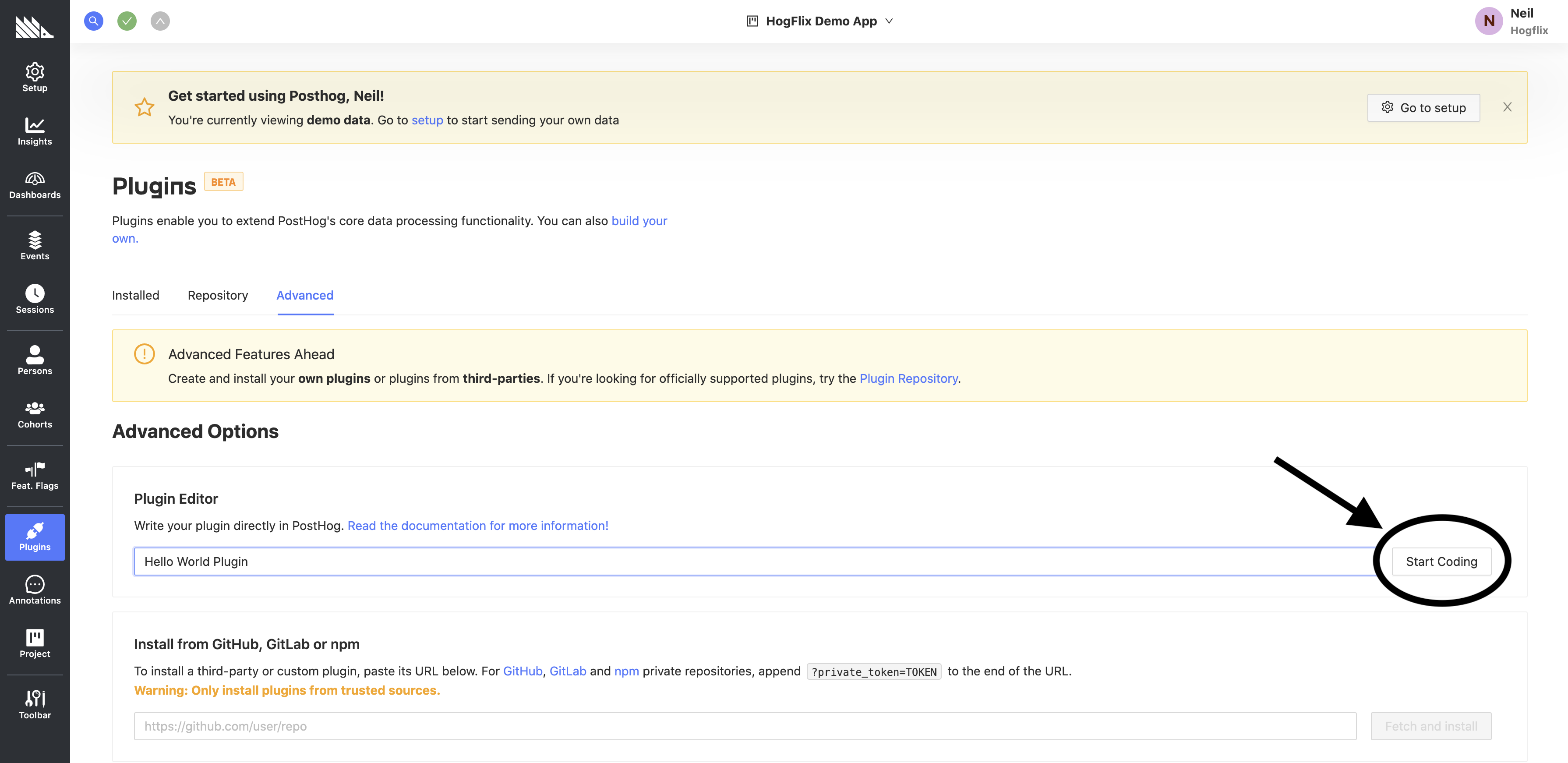
App editor location

Then, click on "Edit Source", and you're good to go. Copy your code and config into the editor, and you're ready to test the app.

Using a GitHub repository

We have a GitHub template (GH login required) which helps you create a new repository with all the right files. There are only two files which make up the entire app: the index.js and plugin.json. Your code goes into index.js, and your configuration goes into plugin.json.

Other than this, there's the index.test.js file for tests, and package.json for package dependencies and metadata.

Remember to update package.json with the appropriate metadata, like name, description, and maintainer.

Once you've written the code in this new repository, you can run it by installing it locally in PostHog. See testing for more information.

App naming conventions

When creating your repository, follow the naming convention of posthog-<plugin-name>-plugin. For example, the hello world repository would be called posthog-hello-world-plugin.

Converting a source app to a GitHub repository

If you wish to submit your app to the official repository, you need to convert it into a GitHub repository. The easiest way to do this is to start with the template and copy your source code into index.js and your config into the config field of plugin.json. Then update package.json with the appropriate metadata, like name, description, and maintainer.

See submission instructions for how to submit the app to the PostHog Repository.

Testing

For now, the best way to test apps is to install them locally.

  • If you're writing a app in the App source editor, this is as easy as clicking "Save".
  • If you're writing a app in a GitHub repository, install it locally using the "Install Local App" option in the Advanced Tab.
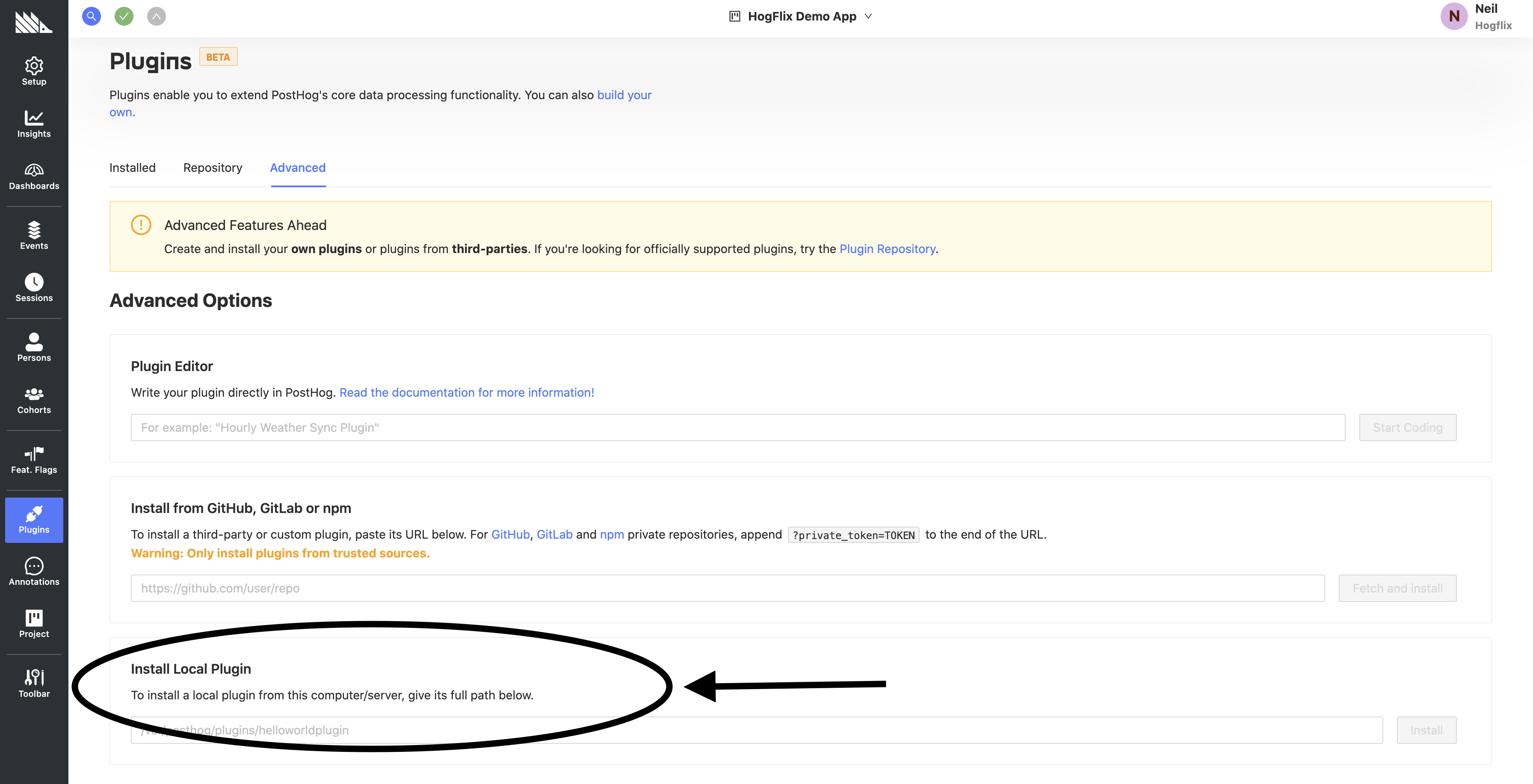
Install app location

This allows you to tweak your app and see that everything works fine.

Debugging

Apps can make use of the JavaScript console for logging and debugging.

These logs can be seen on the 'Logs' page of each app, which can be accessed on the 'Apps' page of the PostHog UI.

Publishing your app

There are four ways to use apps you build:

  1. Publish the app to npm and install it with the url from npmjs.com

  2. You can add it via its repository URL (e.g. GitHub/GitLab)

  3. Reference the location of the app on your local instance (e.g. /Users/yourname/path/to/app)

    This can be configured in 'Settings' -> 'Project Apps'.

  4. Submit it to the official repository. See below

Submitting your app

If you wish to, you can contribute back to the PostHog community by submitting to the official App Store. This means everyone else can use your app, too!

If you built a app inside the PostHog editor, first convert it to a GitHub repository

To submit, email your GitHub URL to hey@posthog.com

Once we get your email, we review the app to ensure it's secure, performant, and adheres to best practices. Then, we add it to our official repository and make it available for everyone to use.

Questions?

Was this page useful?

Next article

Troubleshooting

App server is offline If the server is offline, you need to update your PostHog deployment and/or manually start the server. Heroku When you update to the latest version of PostHog, the app server should start automatically. If it doesn't you need to make sure that a worker dyno is running. You have the choice to enable any of the following dyno types: celeryworker - runs celery, the default background worker pluginworker - runs posthog-plugin-server worker - contains both celeryworker…

Read next article

Share

Jump to:

  • Prerequisites
  • The app
  • Using the app source editor
  • Using a GitHub repository
  • Converting a source app to a GitHub repository
  • Testing
  • Debugging
  • Publishing your app
  • Submitting your app
  • Questions?
  • Edit this page
  • Raise an issue
  • Toggle content width
  • Toggle dark mode
  • About
  • Blog
  • Newsletter
  • Careers
  • Support
  • Contact sales

Product OS suite

Product overview

Analytics
  • Funnels
  • Trends
  • Paths

Pricing

Features
  • Session recording
  • Feature flags
  • Experimentation
  • Heatmaps

Customers

Platform
  • Correlation analysis
  • Collaboration
  • Apps

Community

Discussion
  • Questions?
  • Slack
  • Issues
  • Contact sales
Get involved
  • Roadmap
  • Contributors
  • Merch
  • PostHog FM
  • Marketplace

Docs

Getting started
  • PostHog Cloud
  • Self-hosted
  • Compare options
  • Tutorials
  • PostHog on GitHub
Install & integrate
  • Installation
  • Docs
  • API
  • Apps
User guides
  • Cohorts
  • Funnels
  • Sessions
  • Data
  • Events

Company

About
  • Our story
  • Team
  • Handbook
  • Investors
  • Careers
Resources
  • FAQ
  • Ask a question
  • Blog
  • Press
  • Merch
  • YouTube
© 2022 PostHog, Inc.
  • Code of conduct
  • Privacy
  • Terms